PMP Salary Survey 2026: What Project Managers Should Compare

Essowè Abalo
U.S. PMP holders reported a median salary of $135,000, compared with $109,157 for professionals without the certification, according to industry research published in late 2025. That’s useful context when searching for the pmp salary survey 2026, but it isn’t a survey conducted in 2026, and the comparison doesn’t mean certification guarantees a raise.

It’s understandable to want one clear number for what a PMP is worth. In practice, salary figures vary by location, role, experience, industry, and survey methodology. A global result can provide context, but it may tell you little about pay for a comparable role in your local market.

This article explains how to read the latest compensation findings, compare salary data on a like-for-like basis, and assess the factors that matter to your situation. You’ll also learn how to use credible evidence to plan your professional development or prepare for a compensation discussion, without treating certification as a salary promise.

Key Takeaways

  • Read the pmp salary survey 2026 alongside its publication date and methodology to understand which findings are current.

  • Before comparing salaries, align the geography, compensation measure, and role definitions across sources.

  • Consider how experience, industry, project scale, and decision-making responsibility affect comparisons.

  • Build a compensation discussion around your responsibilities and performance, not a credential alone.

  • Use salary findings to clarify a career goal, identify a skill gap, and choose a practical next step.

Table of Contents

I.  What the PMP Salary Survey 2026 Can and Cannot Tell You

A salary survey reports compensation shared by its respondents. It doesn’t predict what every PMP holder earns. When looking up the pmp salary survey 2026, check when the underlying data was collected rather than relying on the year in an article title.


The latest identified findings come from the 14th edition of Earning Power: Project Management Salary Survey. PMI conducted the fieldwork from March to April 2025 and published the report in November 2025. It covers respondents in 21 countries, so describe it as the 2025 survey, not as research conducted in 2026. Before applying a result, review the report’s methodology, including its respondent groups, locations, and definitions.

A.What does a PMP salary survey measure?

A PMP salary survey summarizes compensation reported by respondents, often grouping results by certification status or location. Use terms such as “salary” or “total compensation” only as the source defines them. Check whether each group includes PMP-certified respondents, people with other credentials, or people without certification.

This differs from job-board estimates, which may reflect advertised salary ranges or modeled estimates for vacancies. Occupational averages group workers by occupation and use their own collection methods. These sources can each provide useful context, but their figures aren’t interchangeable. The overview of  project management principles provides background on the range of work the profession covers.

B. Why is a survey result not a personal salary promise?

Survey results describe a respondent sample, not every project manager in every labor market. A reported difference between PMP and non-PMP respondents can show an association, but it doesn’t establish that certification alone caused the difference. Experience, role scope, seniority, industry, and local market conditions may also contribute, and these factors can overlap.

For example, certified respondents may also hold more senior roles or have broader responsibilities than people in a comparison group. Unless the report’s method separates these influences, don’t attribute the compensation difference to certification alone. Treat the survey as a reference point, then compare your responsibilities and market with those of similar roles.

If you’re considering PMP preparation as part of a broader development plan, explore the free PMP demo. Treat training and certification as professional development, not as a promise of a particular salary outcome.

II. How to Read PMP Salary Survey Data Without Misreading the Numbers

Read salary findings in a consistent order: verify the source, date, geography, respondent group, compensation definition, and role scope. For the pmp salary survey 2026, don’t assume the article year tells you when PMI collected the data. Use the original report’s dates and definitions, and quote figures only when you can verify them there.

A. Which survey details should you check first?

Use this checklist before relying on a figure or repeating it in a compensation discussion:

  • Publisher and edition: Identify who produced the report and which edition the figure comes from.


  • Dates: Record the fieldwork period and publication date separately. They answer different questions.


  • Respondents and locations: Note the respondent count, countries or regions covered, and the group represented by the figure. If a detail isn’t disclosed, flag it rather than infer it.


  • Compensation definition: Check whether the report measures base salary or total compensation, and whether it includes bonuses, benefits, or other pay.


  • Role definitions: Confirm how the survey describes project management roles and separates PMP holders from other credential groups or respondents without certification.


These distinctions affect what a figure means. A median is the midpoint of reported values; a mean is their arithmetic average. They can differ when compensation varies widely. Base salary refers to pay before additional components, while total compensation may include other forms of pay as defined by the source. Don’t compare or relabel these measures as if they were interchangeable.

B. How should you compare survey editions and sources?

Compare like with like: similar roles, geographies, currencies, and compensation measures. Check whether currency conversion, inflation adjustments, or changes in respondent profiles affect the comparison. A difference between survey editions doesn’t automatically show salary growth if the samples or methods have changed.


Keep source types distinct, too. The U.S. Bureau of Labor Statistics publishes occupational information for project management specialists, including median pay and employment projections. Its Bureau of Labor Statistics data on project management specialists provides occupational context, but it isn’t a PMP-specific survey. When comparing figures, record the source and the definition behind each one. If the original report doesn’t explain its method, state that limitation instead of filling in the gaps.


After assessing the evidence, consider how structured PMP preparation fits your broader development goals. Certification doesn’t guarantee a particular compensation outcome.


III. Which Factors Shape PMP Salary Beyond the Certification?

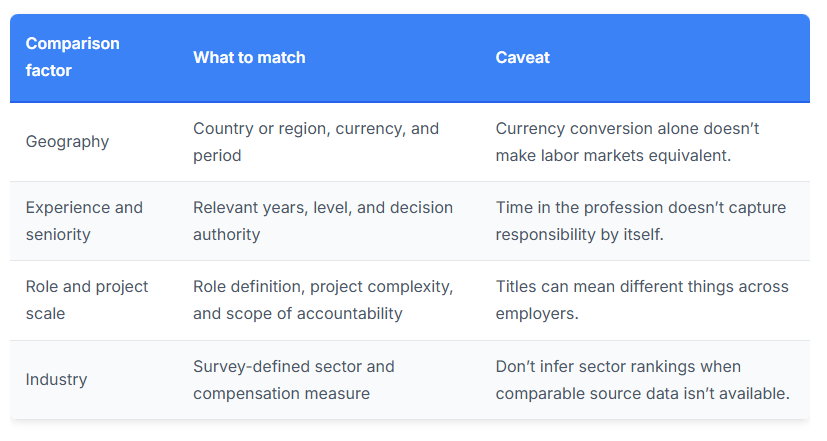
Salary comparisons are most useful when they account for the work and market behind the job title. Geography, experience, role scope, project scale, industry, and decision-making responsibility can all affect whether two compensation figures are comparable. Read a pmp salary survey 2026 through these variables, not as a ranking of credentials alone.


A. How do geography, experience, and industry affect comparisons?

Start with location. Different currencies and labor markets make global figures difficult to compare directly. A simple currency conversion doesn’t account for differences in local employment or cost contexts. Keep location-specific data separate unless the source provides a clear basis for comparison.


Experience needs context as well. Years in project management don’t necessarily indicate seniority, project complexity, or the level of decisions a person owns. Apply the same care to industry comparisons: report differences only when the survey defines its industry groups and provides comparable data. Don’t label a sector the highest-paying based on an unsupported or mismatched comparison.


Job titles can also conceal differences in accountability. A project manager may lead delivery of an individual project, while a program manager coordinates related work toward broader outcomes. A portfolio leader may oversee a set of investments or initiatives. These scopes aren’t interchangeable, even when titles or responsibilities overlap across organizations.
B. Does PMP certification guarantee a higher salary?

No. PMP certification doesn’t guarantee a specific salary, raise, or promotion. A survey may show different compensation among certified and non-certified respondents, but that comparison alone can’t establish that the credential caused the difference. Certified respondents may also differ in experience, seniority, role scope, or career history.


For a fair comparison, look for people doing similar work in comparable markets, then assess the responsibilities and outcomes you can demonstrate. Career development also involves leadership and communication. Explore this  project management leadership guide  as a related resource.

PMP Salary Data • Reading Guide

Six checks before trusting a PMP salary figure

A survey can offer useful context, but the number only makes sense when you know who it represents and how it was measured.

A salary finding is a reference point

Salary differences in a survey show associations in the data. They are not proof that a credential alone causes a pay change. Read the figure as context, then check how it was built.

The reading sequence

Follow the evidence, step by step

from source to fair comparison

Verify the source

Who produced the figure?

Identify the publisher and report edition. Use the original report when possible, rather than a secondary summary that may drop definitions or caveats.

Check the timing

Separate data collection from publication

Record when the survey fieldwork took place and when the report was released. Markets move; a lag can change how useful the figure is for today.

Understand the sample

Who and where does it represent?

Note the respondent group, locations, and respondent count. The cited PMI survey covers 21 countries—check whether your market is among them and how it is grouped.

Define the pay measure

Know what “salary” includes

Confirm whether the figure is base pay only or includes bonus, benefits, or total compensation—and whether it uses median or mean.

Median

The middle value when responses are ordered. Less skewed by extremes.

Mean

The arithmetic average. Can be pulled up or down by outliers.

These measures can differ and should not be treated as interchangeable.

Match the role and group

Compare people doing comparable work

Align the figure with a similar job scope, industry, and experience band before treating it as a personal benchmark.

Role scope Seniority Credential group

Compare like with like

Align the market before drawing a conclusion

Place the survey figure next to a comparable market, currency, and time window. Avoid mixing unlike sources as if they measured the same thing.

A practical framework for reading compensation research woloyem.com

IV. How to Use PMP Salary Data in a Career or Pay Discussion

Use salary data as context for a conversation, not as a promised outcome. Compare credible sources that match your role and location, then pair those benchmarks with evidence of your responsibilities, results, and professional goals. The pmp salary survey 2026 can inform your questions, but one headline figure can’t determine what an employer will offer or what a new role should pay.

A. How can you prepare for a compensation conversation?

Before a review or job discussion, gather information that explains both the market comparison and your contribution. Keep each source and its date with your notes so you can describe the evidence clearly.

  • Find comparable roles: Match location, job scope, seniority, and compensation definition across credible sources.

  • Document your responsibilities: Note the projects you lead, decisions you own, stakeholders you coordinate, and changes in your role.

  • Record outcomes: Prepare specific examples of delivery, risk management, team coordination, or other contributions relevant to your work.

  • Check the evidence: Keep each source’s publication date and methodology, and distinguish reported salary from total compensation where relevant.

  • Set a discussion goal: Decide whether you’re seeking a compensation review, clearer expectations for advancement, or feedback on your next career step.

Frame the discussion around your contribution and role scope, rather than certification alone. For example, explain how your responsibilities have changed and use comparable role data to support a conversation about alignment. Adapt your approach to local workplace norms and your organization’s expectations. Benchmarking can help you prepare, but it doesn’t guarantee a particular negotiation result.

B. How can salary insights inform professional development?

Use salary research to identify questions about your next role, then assess the capabilities it requires. A gap might involve leading complex work, communicating with stakeholders, or connecting project decisions to business priorities. Choose learning based on that gap, not on an assumption that a credential will automatically raise your pay.


If PMP certification is part of your development plan, consider PMP certification preparation as one learning resource. Assess how structured preparation fits alongside practical experience and the responsibilities you want to take on.

V. What the PMP Salary Survey Means for Your Next Career Step

Use salary findings to guide a career decision, not make it for you. Compare compensation for similar roles in relevant markets, then weigh the evidence against your responsibilities, goals, and skills. The pmp salary survey 2026 is useful only when you verify which survey edition and collection period support its findings.


The latest identified Earning Power: Project Management Salary Survey is the 14th edition, fielded from March to April 2025 and published in November 2025. Keep those dates attached to its findings. The article’s 2026 context doesn’t change the survey’s collection date.

A. When might PMP preparation fit your career plan?

PMP preparation may fit if it supports the project responsibilities you already hold, the role you’re targeting, or a specific learning need. A salary survey alone isn’t enough reason to pursue certification. First consider whether the learning aligns with your professional direction and the requirements of your target roles.


Use this decision sequence before choosing a next step:

  • Validate the evidence: Check the report edition, dates, geography, respondent group, and compensation definitions.

  • Assess your career goal: Identify the role or responsibility you want to pursue, rather than focusing only on a salary figure.

  • Identify a skill gap: Compare your current capabilities with the needs of that role.

  • Choose a relevant action: Consider practical experience, focused learning, or certification preparation based on the gap you’ve identified.

If you’re exploring whether PMP learning fits your goals, start with the  free PMP demo. It lets you experience the learning before deciding whether further preparation is right for you.

B. What should readers remember about 2026 salary claims?

Use “2026” to describe the article’s context, not the survey’s fieldwork unless the source confirms that date. State the report edition and collection period beside any finding you quote. Don’t present an association between certification and compensation as proof that the credential caused a salary outcome.


The practical takeaway is simple: salary survey findings describe reported compensation for a defined respondent group, not guaranteed earnings for every project manager. Interpret them alongside comparable roles, markets, and career goals. Professional training can build capability, but it can’t promise a raise or promotion. If structured PMP preparation aligns with your next step, explore the PMP bootcamp as a learning option.

VI. Make Your Next Career Move With Better Evidence

The pmp salary survey 2026 is most useful as a starting point, not a salary promise. Check the report edition, collection dates, geography, and definitions before applying its findings. Then compare roles with similar responsibilities and market conditions, and use your results and career goals to guide a pay discussion or development decision.

The latest identified Earning Power: Project Management Salary Survey is the 14th edition, fielded from March to April 2025 and published in November 2025. Keep those dates attached to any findings you cite. Certification may be one part of professional development, but your responsibilities, experience, and capabilities matter too. No survey or training can guarantee a particular salary or promotion.

If PMP preparation fits your career direction, explore the free demo. Woloyem offers training in English and French.  Explore the free PMP demo to experience the learning and decide on your next step. Build your plan around evidence and choose development that supports your goals.

VII.  Frequently Asked Questions

Does PMP certification increase your salary?

A salary survey can show a compensation difference between PMP-certified and non-certified respondents, but that doesn’t prove certification alone caused it. Experience, seniority, role scope, and market conditions may also differ between groups. Treat survey findings as context, not a promise of a raise or promotion. For a useful comparison, check whether respondents hold similar roles and work in comparable markets.

What is the average PMP salary in 2026?

No verified survey collected in 2026 is identified here, so avoid presenting a figure as a 2026 average. The latest identified source is the 14th edition of Earning Power: Project Management Salary Survey, fielded from March to April 2025 and published in November 2025. It reported a U.S. median salary of $135,000 for PMP holders. That is a median, not an average, and reflects the survey’s respondent group.

Which country has the highest PMP salary?

The available information doesn’t establish which country has the highest PMP salary, so naming one would be unsupported. The 14th edition of Earning Power: Project Management Salary Survey covered respondents in 21 countries, but country comparisons depend on consistent salary measures, currencies, respondent groups, and methods. Review the original report’s country-level findings and definitions before drawing a conclusion. Currency conversion alone doesn’t make markets directly comparable.

Do PMP salaries vary by experience and job title?

They can, but the scale of any difference should be supported by a source with clear definitions. A project manager leading a project, a program manager coordinating related work, and a portfolio leader overseeing investments may have different responsibilities. Compare similar levels of seniority, decision authority, project complexity, geography, and compensation measure. Job titles alone may not show whether two roles have comparable scope.

Is a PMP salary survey the same as a project manager salary report?

No. A PMP salary survey may group compensation by certification status, while a project manager salary report may organize results by occupation, job title, or another category. Sources can also use different samples and compensation definitions. For example, the U.S. Bureau of Labor Statistics publishes occupational information for project management specialists, which isn’t the same as a PMP-specific survey. Compare what each source measures before using figures together.

How reliable are PMP salary surveys?

A PMP salary survey is more useful when its publisher, collection dates, respondent group, covered locations, compensation measures, and role definitions are clear. It still describes reported compensation for a sample, not every PMP holder. Review the original report and note any missing methodology rather than guessing. Comparing multiple credible sources can provide context, provided their roles, markets, and measures are sufficiently similar.

How can I use PMP salary data to prepare for a salary review?

Use salary data as supporting context, then prepare evidence about your role and contribution. Match benchmarks to your location, responsibilities, seniority, and compensation measure. Record each source’s date and methodology, and gather examples of outcomes, expanded responsibilities, or complex work you’ve led. Frame the discussion around role scope and performance rather than certification alone. Adapt your approach to your organization’s review process, and don’t assume survey figures guarantee a negotiation result.

Our successes

Our successes with the "Un Coup K.O." method
Our successes

Courses

Privacy Policy Cookie Policy Terms and Conditions