
{ "@context": "https://schema.org", "@type": "LocalBusiness", "name": "Woloyem", "image": "https://lwfiles.mycourse.app/643c63c75d76f37a1d90449f-public/14c34389d3f71f557e817e7e6f418779.png", "@id": "", "url": "https://www.woloyem.com/", "telephone": "+225 07 04 45 7587", "priceRange": "€€", "address": { "@type": "PostalAddress", "streetAddress": "Immeuble WOW, Boulevard Germain Koffi Gadeau", "addressLocality": "Abidjan", "postalCode": "", "addressCountry": "CI" }, "geo": { "@type": "GeoCoordinates", "latitude": 5.3647944, "longitude": -3.9497709 }, "openingHoursSpecification": { "@type": "OpeningHoursSpecification", "dayOfWeek": [ "Monday", "Tuesday", "Wednesday", "Thursday", "Friday", "Saturday", "Sunday" ], "opens": "08:00", "closes": "22:00" }, "sameAs": [ "https://www.facebook.com/woloyem.consulting", "https://x.com/woloyem", "https://www.instagram.com/woloyem/", "https://www.linkedin.com/company/woloyem-consulting-academy/", "https://www.woloyem.com/" ] }

ITIL in Banking and Finance: A Practical Guide for 2026

Essowè Abalo
Could a bank improve service reliability without turning every support decision into another approval step? That’s the practical question behind itil in banking and finance. Service-management practices can bring structure to incidents, recurring problems, changes, and supplier interactions. They work best when they reflect the organization’s risks and priorities.

Financial-services teams face complex demands: restore important services promptly, manage technology changes carefully, and coordinate work across business and IT teams. It’s reasonable to ask whether another framework will improve outcomes or simply add process. ITIL offers guidance for managing services, but it doesn’t replace an organization’s governance, risk, or control frameworks. Adopting it doesn’t guarantee compliance.

This guide explains where ITIL can help in banking and finance, with practical use cases and a measured approach to implementation. It also compares ITIL with complementary frameworks, so you can distinguish service-management guidance from governance and control responsibilities. Finally, we’ll consider what ITIL (Version 5) means for organizations using ITIL 4, and how to assess whether a practice improves service outcomes rather than just adding steps.

Key Takeaways

  • Use ITIL guidance to organize service work around clear ownership, communication, and learning, not to impose a one-size-fits-all process.

  • Assess itil in banking and finance by starting with a specific service issue and its impact on users.

  • Compare ITIL with other frameworks by purpose, scope, and users. Related terminology doesn’t make them interchangeable.

  • Introduce one focused improvement, then review whether it improves service outcomes before expanding the approach.

  • Build ITIL knowledge to strengthen service-management understanding, while recognizing that training complements rather than replaces practical experience.

Table of Contents

I. What does ITIL in banking and finance mean in practice?

ITIL in banking and finance means using service-management guidance to organize how technology services are delivered, supported, and improved. ITIL is not a banking regulation or a compliance certificate. It can help teams clarify responsibilities and coordinate service work, but each organization must decide how the practices fit its services, risks, operating model, and obligations.


Dependable technology supports customer-facing activity as well as the internal work that enables it. Disruptions to digital banking or payment services can affect customers. Problems with employee technology or support operations can slow internal work. The ITIL (Information Technology Infrastructure Library) overview provides background on the framework’s history and concepts.


For a brief introduction to the framework, watch this video:

In short, ITIL offers guidance for managing IT services. It does not assure regulatory compliance. That distinction matters: service practices can support consistent operations, but compliance decisions and evidence remain the organization’s responsibility.

A. Which banking and finance services can benefit from ITIL practices?

Potential applications include digital banking, payment services, employee technology, and support operations. These are examples, not a universal map of how every financial institution is organized. Start by identifying a service, its owner, the people who use it, and the impact they experience when it’s unavailable or difficult to use.

Customer-facing services, such as a digital banking channel, directly shape customers’ access to services. Internal platforms and enabling services, such as workplace technology or support operations, help employees deliver that work. Because users and impacts differ, service ownership, priorities, and communication should reflect the context.

B. What ITIL does not do for a financial institution

Adopting ITIL practices alone doesn’t demonstrate that an institution meets its regulatory obligations. ITIL is guidance, not a technical product, software platform, or certification mandate for banks. Nor should its practices replace organizational controls. Before changing service processes, consult qualified internal compliance and risk specialists about applicable obligations, evidence, and approval requirements. Tailor the approach to the institution’s services, risks, and operating model rather than applying a template by default.

II. How can ITIL practices support financial-services operations?

ITIL practices can help financial-services teams organize service work, clarify ownership, and learn from operational issues. They’re adaptable guidance, not mandatory templates. For itil in banking and finance to be useful, teams should choose practices that fit the service, its users, and the risks involved.


The same practice may need different handling across services. An investment-banking example in  ITIL frameworks for investment banks  can offer a useful point of comparison, but each organization still needs to assess its own operating context.


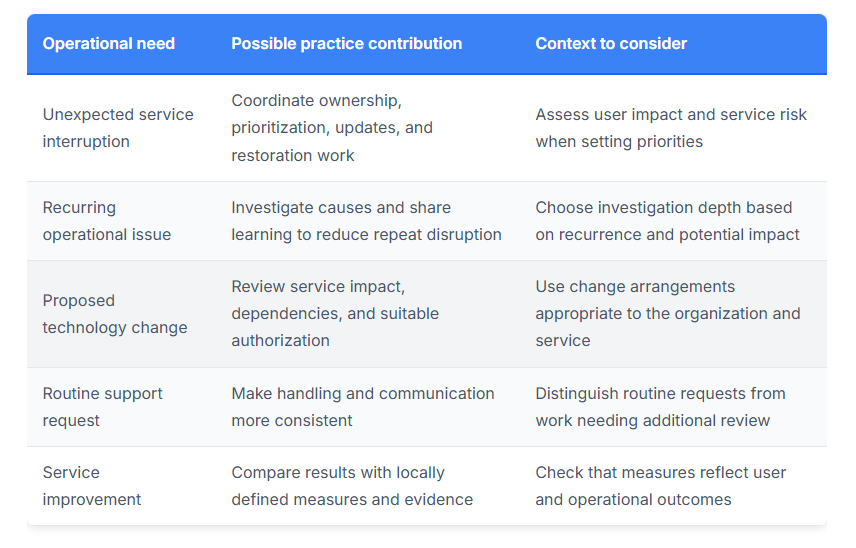
ITIL practices should fit the service context and risk, not force every team into one process. The table shows how teams might apply that principle:
A. Incident and problem management in financial services

Incident handling can give teams a shared way to assess impact, assign an owner, coordinate updates, and work toward restoring service. Problem management looks beyond the immediate interruption to investigate recurring causes, rather than repeatedly treating symptoms.


Illustrative example: If a staff-facing transaction reporting tool becomes unavailable, a team could assign an incident owner, communicate the known impact, and coordinate restoration. If similar interruptions recur, a separate investigation could examine contributing causes and possible improvements. This example doesn’t prescribe a recovery time or outcome.

B. Change enablement, service requests, and continual improvement

Change decisions can take potential service impact, dependencies, and appropriate authorization into account. ITIL doesn’t prescribe one universal banking change-control design. Teams should align their approach with the service and relevant internal requirements. Request handling can also make routine support work more predictable through clear routing and user communication.


For continual improvement, review evidence against locally defined measures, such as patterns in repeat issues or feedback on request handling. A review should help teams decide what to adjust, retain, or investigate further. If your team wants to build a shared service-management vocabulary, explore  ITIL training from Woloyem.

III. ITIL and other frameworks in banking: what should you compare?

Compare frameworks by the organizational question they help answer, their scope, and who uses them. ITIL focuses on service-management guidance. Other approaches may address service-management system requirements, enterprise technology governance, or an institution’s own risk and control needs. Shared terms don’t make these approaches interchangeable.


The  ITIL framework provides guidance for organizing and improving IT service work. Before choosing or combining frameworks, clarify whether the need is to improve day-to-day service operations, establish a formal management system, guide governance, or meet internal control objectives.
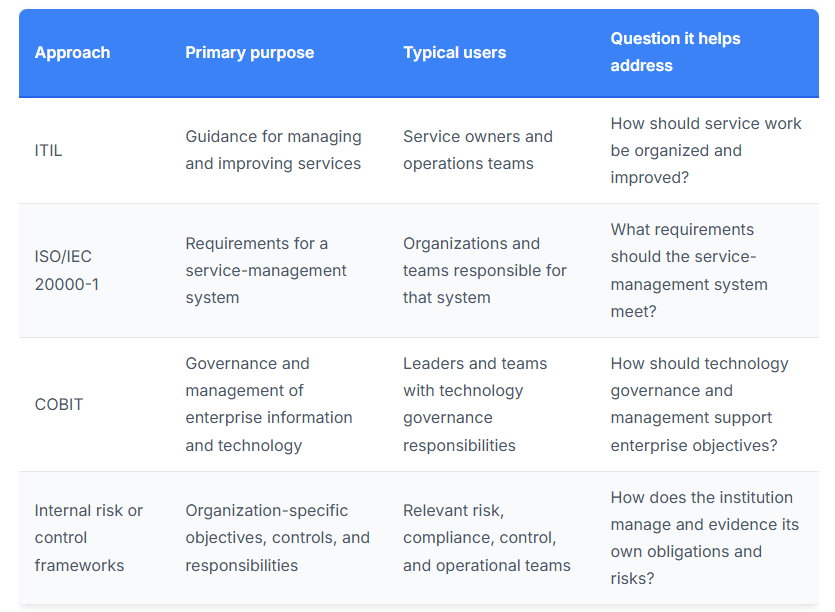
Organizations can use complementary frameworks for distinct needs, provided they define how responsibilities fit together. This can help when service teams need operational guidance while governance or control owners need clear accountability and evidence.


A. ITIL and ISO/IEC 20000: guidance compared with a service-management standard

ITIL offers guidance; ISO/IEC 20000-1 sets requirements for a service-management system. Using ITIL doesn’t automatically establish conformity with the standard or confer certification. Before pursuing formal conformity, clarify the intended scope, business reason, accountable owners, and evidence to maintain. Confirm current requirements with ISO and qualified specialists.

B. ITIL, COBIT, and internal risk or control frameworks

Compare ITIL, COBIT, and internal frameworks by their roles in operational service management and governance, rather than treating them as substitutes. Map who owns each activity, which framework informs it, and what evidence is already produced. This can reveal where processes complement one another and where duplication may be unnecessary. For foundational context, consult the ITIL certification guide from Woloyem.


Service management, tailored to risk woloyem.com

A practical guide

ITIL in Banking and Finance

Use service management guidance to organize support, changes and learning—without mistaking it for a compliance framework.

Clear ownership Risk-aware practices Service outcomes first

The essential distinction

Guidance for managing services. Not proof of regulatory compliance.

ITIL helps keep services operationally healthy. It is not a checklist that proves regulatory compliance on its own.

Where it may hurt

Four service-work challenges

Choose practices according to the service, its users and the risk involved.

Unexpected service interruption

Incident response

Focus on restoring service quickly. Do not let a rigid process slow down critical repairs when users need the service back.

Recurring operational issue

Problem investigation

Investigate root cause without blaming. Move beyond a quick fix to understand recurrence and potential impact.

Proposed technology change

Change management

Review impact and dependencies, with authorization arrangements suited to the change and its context.

Supplier interactions

Coordination

Use service-management practices to structure supplier interactions, shaped by service levels and operating needs.

Start with one service

A measured way to introduce ITIL practices

Focus on a real service issue, introduce a targeted improvement, then assess the result before expanding.

  1. A
    Select a service issue

    Start with a specific operational problem, not a framework rollout for its own sake.

  2. B
    Map users and impact

    Identify who is affected, how, and what matters most to stakeholders—not just the IT team.

  3. C
    Tailor the practice

    Fit roles, communication and process to the service, its risks and the department’s operating model.

  4. D
    Introduce one focused improvement

    Keep the change specific enough to assess, rather than adding layers by default.

  5. E
    Review service outcomes

    Check whether the changes made a difference, talking with the people using the service.

Service context matters

Different services, different impacts

The scope and detail of ITIL practice depends on what the business needs from each service.

Customer-facing

Digital banking

High availability matters. Change and incident management must be responsive.

Customer-facing

Payment services

Continuity is critical. Keep a strong focus on risk, failover and controlled change.

Internal employee

Employee technology

Efficiency and self-support are key. ITIL helps simplify how people get work done.

Internal employee

Support operations

Stability and reporting matter. Build clear flows for internal work that can be measured.

Version consideration

Using ITIL 4?

Assess what ITIL 4 means for your organization and service-management needs. Judge practices by whether they improve service outcomes, not by adding scope alone.

ITIL 4 ← ITIL (version 3)
The practical test: clearer ownership, better coordination and useful learning for the service and its users. woloyem.com

IV. How should a bank assess and introduce ITIL practices?

Start with a specific service problem and its impact on users, not a broad framework rollout. A practical assessment defines the service, reviews how work currently happens, selects one focused improvement, and checks the results before considering wider adoption. This keeps itil in banking and finance  grounded in operational needs rather than process for its own sake.


Involve the people who understand the service and its constraints. Depending on the issue, that may include service operations, technology, business teams, and risk or compliance specialists. Their input can surface dependencies, clarify decision rights, and identify considerations a process change must respect.

A. Choose a suitable service and establish the baseline

Define who uses the service, where its boundaries sit, who owns it, and which other services or teams it depends on. Then describe the specific problem to address, such as unclear ownership of a recurring support issue or inconsistent communication about service requests.


Review available incident, request, change, and service-feedback information to understand current work. Use what the organization can reliably observe as a baseline, and involve relevant risk and compliance stakeholders before changing operational processes. If the evidence is incomplete, record that limitation rather than assuming a starting point.

B. Pilot, measure, and adapt without overengineering

Choose a limited pilot scope, such as one service or a defined part of its support work. Before starting, document assumptions, responsibilities, and decision points. Agree with stakeholders on locally meaningful measures. These might include whether ownership is clearer, how consistently users receive updates, or whether recurring issue patterns change.


Compare results with the baseline and consider unintended effects. A new approval step, for example, may clarify authorization but also create extra delays for routine work. Use the evidence to adjust the approach, keep what helps, and reconsider what adds effort without a clear benefit. Don’t claim savings, risk reduction, or improved performance unless the organization has measured and supported that result.


A simple review can ask: Did the change address the original problem? What did users and teams experience? What evidence supports the conclusion? What should change before the pilot continues or expands? Wider adoption should follow learning, not assumption.


For organization-level support, learn more about Woloyem’s corporate consulting and training.

V. How can ITIL knowledge help banking and finance professionals?

ITIL knowledge can help financial-services professionals understand service-management concepts and apply them more deliberately in their roles. Its value depends on the learner’s work context. Training can build a shared vocabulary, but it can’t replace organizational experience, local procedures, or role-specific judgment.

A. Who may benefit from ITIL learning in financial services?

ITIL learning may be relevant to service owners, IT operations and support teams, and professionals involved in technology or service transformation. Each person may apply the concepts differently:
  • Service owners can use service-management knowledge to clarify responsibilities and consider user impact.

  • Operations and support teams can build an understanding of how service work is coordinated and reviewed.

  • Transformation professionals can use a shared service-management vocabulary when discussing operational changes with business and technology teams.

These are illustrative audiences, not a promise of a specific career outcome. A support professional might focus on how work is assigned and communicated, while a transformation lead may need to understand how a change affects service ownership and operations. In either case, learners should connect concepts to their organization’s actual ways of working.

B. How to evaluate ITIL training for your organization or career

Before choosing a course, check that its description names the framework and version it covers, identifies intended learning outcomes, and explains who the learning is designed for. Confirm that the terminology is current with the provider, and ask how the course relates to the service-management work you need to understand.

Also confirm that the language and delivery approach suit your needs. Woloyem offers training in English and French. Check the provider’s current course details to confirm the options relevant to you. If you’re learning for workplace application, consider whether you can connect the material to a real service, process, or improvement question.

Training can support understanding, but it doesn’t establish that an organization follows a framework, satisfy compliance obligations, or substitute for hands-on experience. For a practical next step, identify one service-management question tied to your role, then compare it with the course’s stated outcomes. Review  Woloyem’s ITIL training information to see whether it aligns with your learning goal.

VI. Make your next ITIL step specific to your service

ITIL in banking and finance is most useful when it helps teams address a real service need. Choose a service issue, understand its user impact, and tailor relevant practices to the service’s risks and operating context. Compare frameworks by what they’re designed to help with, and don’t treat ITIL guidance as proof of compliance.

For professionals, ITIL learning can build service-management understanding, but applying that knowledge still depends on workplace experience and organizational requirements. Start by identifying what you need to learn: clearer service ownership, better coordination of operational work, or a stronger foundation for a transformation role.

Woloyem offers ITIL® certification training as well as corporate consulting and training, with training available in English and French. Review the course information and confirm current details to see whether it fits your learning goal. Explore Woloyem ITIL training as a practical next step. Choose one relevant objective, build your understanding, and apply it thoughtfully to your organization’s services.

VII. Frequently Asked Questions

What is ITIL in banking and finance?

ITIL in banking and finance is service-management guidance that organizations can adapt to how they deliver and support technology services. It can help teams clarify service ownership, coordinate operational work, and learn from issues affecting customers or employees. ITIL isn’t a banking regulation, software platform, or compliance certificate. A financial institution should tailor any practices it adopts to its services, risks, operating model, and applicable obligations.

How is ITIL used in banks?

Banks may use ITIL practices to organize work such as responding to technology incidents, investigating recurring issues, considering changes, and handling service requests. For example, teams supporting a digital banking service could use clear ownership and communication arrangements during an interruption, then examine repeat issues for potential causes. These are adaptable practices, not universal banking procedures. Each organization decides how they fit its services and internal requirements.

Is ITIL relevant to financial services?

Yes. ITIL can be relevant wherever teams manage technology-enabled services that customers or employees rely on. This may include digital banking, payment services, internal platforms, or support operations, depending on the organization. Its usefulness comes from helping teams structure service work, not from being designed as a financial-sector rulebook. Start with a specific service challenge and assess whether relevant guidance could improve ownership, communication, or learning.

Does ITIL guarantee regulatory compliance for banks?

No. Using ITIL practices or earning an ITIL certification doesn’t guarantee that a bank meets regulatory requirements. ITIL provides service-management guidance, while compliance depends on the institution’s obligations, controls, evidence, and implementation. Banks should consult qualified internal compliance and risk specialists when assessing requirements or changing processes. Treat ITIL as a possible operational aid, not a substitute for governance, control frameworks, or professional compliance advice.

What is the difference between ITIL and ISO/IEC 20000?

ITIL is guidance for managing services, while ISO/IEC 20000-1 specifies requirements for a service-management system. They’re related to service management, but they serve different purposes. Applying ITIL doesn’t automatically demonstrate conformity with ISO/IEC 20000-1 or grant certification. Organizations considering the standard should confirm its current scope with ISO and clarify the intended system boundaries, business reason, accountable owners, and evidence needed.

Should a bank use ITIL or COBIT?

The choice depends on the need, and a bank may use both for distinct purposes. ITIL can guide operational service management, while COBIT addresses governance and management of enterprise information and technology. A bank should identify whether it needs to improve service work, clarify governance objectives, or address internal risk and control needs. Map responsibilities and existing evidence before adopting practices, so teams can spot gaps without needlessly duplicating processes.

Does ITIL certification help someone working in finance?

ITIL certification may help someone in finance build service-management knowledge, particularly if their role involves IT operations, support, service ownership, or transformation. Its value depends on the learner’s responsibilities and ability to apply concepts at work. Certification doesn’t replace practical experience, establish compliance, or guarantee a job, promotion, salary increase, or employer recognition. Before choosing a course, check its framework terminology, learning outcomes, language, and relevance to your role.

Our ITIL 5® successes

Our successes with ITIL 5®
ITIL 5®

Courses

Privacy Policy Cookie Policy Terms and Conditions