
Key Takeaways
Table of Contents
I. Why Use PRINCE2 for Clinical Research Projects?
PRINCE2 clinical project governance functions as a process-driven control framework that enforces accountability, tolerance thresholds, and stage boundaries across trial operations. Drug development programs represent massive investments, often costing tens of millions of dollars while navigating failure rates as high as 90%. When you adopt PRINCE2 (PRojects IN Controlled Environments), you introduce predefined exception management. This ensures project managers escalate unexpected site deviations, enrollment drop-offs, or supply disruptions before they create unrecoverable cost overruns.
To examine how clinical project managers integrate governance frameworks into day-to-day operations, watch this practical analysis:
Applying PRINCE2 for clinical research projects does not dilute scientific rigor. The methodology enhances rather than replaces clinical trial protocols, Investigator Brochures, and Statistical Analysis Plans. It wraps structured business governance around operational delivery, ensuring every decision remains fully auditable and aligned with corporate risk appetites.
A. The Reality of Clinical Trial Complexity
B. Reconciling PRINCE2 with ICH-GCP Compliance
II. Adapting PRINCE2 Principles and Themes to Clinical Trial Governance
Tailoring PRINCE2 to suit the project environment is an obligatory core principle. When applying PRINCE2 for clinical research projects, tailoring means translating generic governance stages into regulated trial milestones. Continued business justification cannot simply monitor capital expenditures; it must evaluate therapeutic viability, primary clinical endpoints, and evolving safety signals. Research confirms that deploying effective management systems for clinical trials directly mitigates operational delays and compliance failures.
Management by exception establishes unambiguous tolerance thresholds around critical trial variables. Clinical trial teams frequently struggle with patient retention, where average drop-out rates reach 30%. By defining explicit tolerance limits for recruitment pace, protocol deviations, and site initiation timelines, project managers don't micromanage daily monitoring. Instead, they escalate an Exception Report to the Project Board only when operational performance breaches agreed tolerances.
A. Structuring the Clinical Project Board
PRINCE2 divides project direction into three distinct board roles, eliminating the unclear accountability that often confuses clinical trials:
B. Managing Clinical Risk and Quality Themes
PRINCE2 risk management integrates directly with clinical Risk-Based Quality Management (RBQM) protocols. Project risk registers document operational vulnerabilities alongside clinical hazards, linking site-monitoring frequencies to data integrity risks. Defined quality criteria reflect primary and secondary endpoints rather than subjective milestones. By documenting site activation bottlenecks in structured lessons learned logs, clinical operations teams prevent recurring delays across future study phases.
Life sciences teams looking to master these structured oversight methods can explore specialized PRINCE2 certification pathways to bridge standard project frameworks with complex health authority requirements.
III. PRINCE2 vs Traditional Clinical Trial Management Methodologies
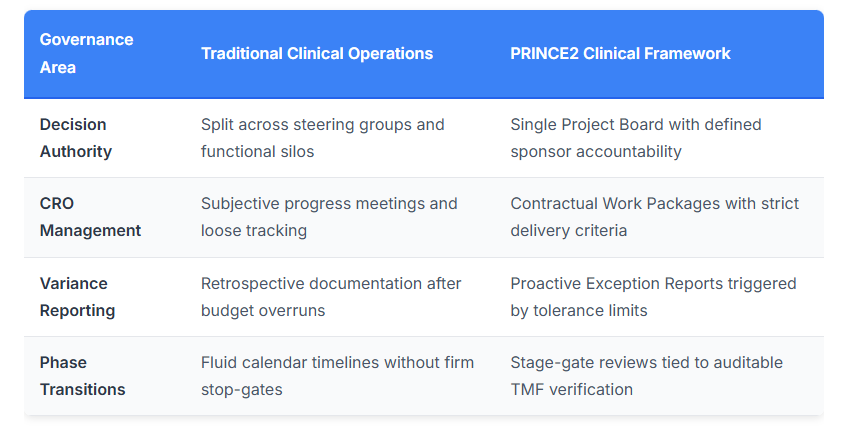
Traditional clinical trial oversight relies heavily on ad-hoc coordination, retrospective monitoring visits, and informal status check-ins. This reactive stance leaves clinical trial budgets vulnerable to sudden expenditure shocks. Applying PRINCE2 for clinical research projects replaces unstructured activity tracking with product-based planning. Instead of tracking vague responsibilities like "managing CRO performance," clinical teams govern work through formal Work Packages that define clear acceptance criteria, quality checks, and cost tolerances before execution begins. Research demonstrates that taking a structured project management approach for research projects gives leadership predictable operational control across multi-center initiatives.
A. Governance Framework Comparison
Clinical operations often confuse comprehensive meeting minutes with actual operational control. Standard trial tracking focuses on what happened in the past, while PRINCE2 uses forward-looking stage boundaries and variance alerts.
B. Overcoming the Rigidity Objection in Life Sciences
IV. Step-by-Step Implementation of PRINCE2 Across Clinical Trial Phases
Deploying PRINCE2 across clinical trial lifecycles requires aligning standard process gates directly to clinical milestones. During the Starting Up a Project stage, teams evaluate preclinical handoff dossiers and draft preliminary trial briefs. The Initiating a Project process then focuses on securing Institutional Review Board (IRB) and Independent Ethics Committee (IEC) approvals alongside formal regulatory clearances. Operational rollouts only proceed once the Project Board formally approves the comprehensive Project Initiation Documentation (PID). Applying PRINCE2 for clinical research projects ensures each clinical phase progresses with auditable sponsor authorization.
A. Managing Protocol Amendments with PRINCE2 Change Control
Uncontrolled protocol modifications derail trial timelines. PRINCE2 change management categorizes changes to maintain operational discipline:
The Project Manager logs substantial amendments in the Issue Register and conducts an impact assessment on budget, regulatory approval cycles, and patient recruitment timelines before submitting the request to the Project Board for binding sign-off.
B. Controlling CRO Deliverables via Work Packages
Rather than relying on high-level vendor service agreements, clinical project managers use PRINCE2 Work Packages to enforce accountability. Each Work Package explicitly outlines required deliverables, including Site Initiation Visit (SIV) completion, electronic Case Report Form (eCRF) monitoring turnaround times, and biological sample transport schedules. Contract research organizations submit weekly Checkpoint Reports that highlight potential tolerance breaches early, ensuring corrective actions occur before data verification milestones slip.
C. Trial Close-Out and Premature Termination Protocols
The Closing a Project process provides structure during site decommission and data finalization. Teams execute formal database lock procedures, verify drug reconciliation logs, complete the final Clinical Study Report (CSR), and transfer the complete Trial Master File to regulatory archives. If an interim analysis triggers an unexpected safety alert, the framework manages premature termination through a controlled Exception Plan, safeguarding patient welfare while preserving research data integrity.
Master these execution techniques by booking our accredited PRINCE2 training programs to lead complex, highly regulated clinical research projects with confidence.
V. Building Clinical Project Excellence with Woloyem
A. Accredited Certification and Tailored Life Sciences Training
B. Strategic Consulting for Healthcare and CRO PMOs
VI. Mastering Clinical Governance for Next-Generation Trial Delivery
VII. Frequently Asked Questions
Can PRINCE2 be applied to clinical trials governed by ICH-GCP?
How does PRINCE2 define the role of a Principal Investigator on the Project Board?
What is the difference between a clinical trial protocol and a PRINCE2 Project Plan?
How does PRINCE2 change control handle substantial protocol amendments?
Is PRINCE2 better than PMP for clinical research project managers?
How do clinical operations use PRINCE2 tolerances during patient recruitment?
Can PRINCE2 stage boundaries align with Phase I, II, and III clinical milestones?
Our successes
.jpg)
.jpg)
.jpg)
.jpg)


.jpg)
.jpg)
.jpg)








.jpg)
.jpg)
.jpg)


.jpg)





.jpg)















.jpg)
























































































.jpg)





































Latest news from our blog
Courses