Table of Contents
PMP® 2026 in 30 seconds
The new exam went live on July 9, 2026. PMI has sharply increased the weight of Business Environment, kept a mix of predictive, Agile and hybrid approaches, brought topics such as AI and sustainability into project scenarios, and moved more questions closer to real workplace situations.
I. The PMP® is no longer quite the exam many candidates still have in mind
For years, a large part of PMP® preparation was built around a broad body of knowledge: processes, tools, techniques, roles, formulas and terminology. Those elements have not disappeared. They still matter. But they no longer fully describe what PMI is trying to assess.
In its communications around the 2026 update, PMI emphasizes outcomes, value, business alignment, judgment, stakeholder engagement and the ability to act in real operating environments. The exam is therefore better understood not as a list of new topics, but as a shift in perspective.
The PMP® 2026 does not only ask, "What do you know?" Increasingly, it asks, "What do you do with what you know?"
This distinction should shape your preparation. Candidates still need to master the concepts, but above all they need to learn how to use them to make decisions, sequence actions and understand the consequences of a choice.
II. Business Environment jumps from 8% to 26%: why this is the biggest shift
The new weighting is 33% People, 41% Process and 26% Business Environment. In the previous version, Business Environment represented just 8%. Its relative weight has therefore more than tripled.
This shift is a reminder that a project never exists for its own sake. It serves a strategy, addresses a problem, creates or protects value, operates in a market, and remains exposed to regulatory, technological and organizational constraints.
Imagine a project delivered on time, within budget and with the agreed scope. Six months later, users have not adopted it and the expected benefits never materialize. From a purely operational point of view, several indicators may still be green. From a business perspective, however, the project has a serious problem.
Delivering the project is not the same as delivering value.
For candidates, this means learning to connect planning, risk, stakeholders, governance and strategy. A single question can combine all of these in one scenario.
III. Predictive, Agile and hybrid: the exam is testing adaptability above all
According to the 2026 Examination Content Outline, around 40% of questions represent predictive approaches. The remaining 60% are split between adaptive/Agile and hybrid approaches. These approaches can appear across all three exam domains.
The implication is important: it is not enough to learn predictive delivery in one chapter and Scrum or Kanban in another. In real organizations, delivery models are often mixed. A development team may work in Agile while budgets, supplier contracts and parts of governance remain strongly predictive.
The best answer is not always the most modern method. It is the method best suited to the context.
Before studying more, measure your actual level.
The PMP® Level ScoreApp helps you identify what you already master and which domains should become priorities in your preparation.
IV. The questions are moving closer to real project problems
The exam still contains 180 questions to be completed in 240 minutes, with two 10-minute breaks. But PMI now places more emphasis on an interactive, scenario-based exam experience. The 2026 ECO refers to case-based and graphic-based questions, as well as the interpretation of data and project artifacts.
This is much more demanding than a simple definition question. A single scenario can include an unhappy sponsor, an Agile team, a materialized risk, a regulatory change and a late supplier. Several actions may look reasonable. The candidate must determine which one is best now, in that specific context.
This changes how simulators should be used. Completing 2,000 questions has limited value if you repeat the same flawed reasoning 2,000 times. What matters is understanding why one answer is stronger than the others, which details in the prompt mattered, and which reflex needs to be corrected.
A simulator is not a machine for producing a score. It is a machine for exposing weak decision patterns.
Put your reasoning to the test with 60 PMP® questions.
After the diagnostic, move into concrete questions and observe where you lose marks, time or confidence.
V. AI is entering the PMP®. But the subject is not ChatGPT
AI does not reduce the need for judgment. It increases the value of good judgment.
VI. Leadership is changing scale as well
VII. PMBOK® 8 is not "the exam syllabus"
Turn your gaps into a study plan.
VIII. Eligibility: your job title does not tell the whole story of your project experience
The 2026 version broadens the eligibility pathways and now uses a 10-year window for project experience. Required experience varies according to the candidate's academic pathway. PMI also clarified an important point in August 2026: you do not need to have officially held the title "Project Manager" for your experience to be relevant.
What matters is the work you actually performed: leading projects, contributing to delivery, guiding a team or stakeholders and helping create value. An engineer, marketing manager, consultant, IT leader or operations manager can therefore build significant project experience without ever having "Project Manager" in the job title.
That does not mean every professional experience automatically qualifies. The application must still meet PMI's criteria and be documented accurately.
See also: WOLOYEM PMP® eligibility and preparation resources.
IX. Why this evolution is happening now
The certification creates the most value when it validates a real ability to turn strategy into results.
X. On December 1, 2026, the rules for the 35 live training hours change
Another major change does not directly concern exam questions. From December 1, 2026, PMI will change the eligibility rules for PMP® training completed live with an instructor, whether in person or remotely.
From that date, hours earned through live training will qualify when the course is delivered by a PMI Authorized Training Partner, a China Registered Education Provider, or an eligible accredited academic program. On-demand or self-paced training follows a different framework and may continue to be offered by other organizations.
It would therefore be inaccurate to say that "only ATP training will count." However, for candidates choosing live training, the provider's status becomes something to verify before enrolling.
WOLOYEM is a PMI Authorized Training Partner.
XI. So how should you prepare for the PMP® 2026 rationally?
The wrong approach is to begin by accumulating resources: several books, dozens of videos, files collected from discussion groups, then hundreds of questions sometimes drawn from different versions of the exam. Candidates end up with a lot of content and very little clarity about what they actually need to improve.
A more logical path works in the opposite direction. Start with a diagnostic, continue with targeted learning, then move into practice and error analysis. After that come longer simulations, time-management work, stamina building and finally scheduling the exam once results become consistently strong.
You do not need to study more. You need to study what is still preventing you from being ready.
Go further
Depending on where you are today, these are the most useful resources to continue your preparation without losing focus.
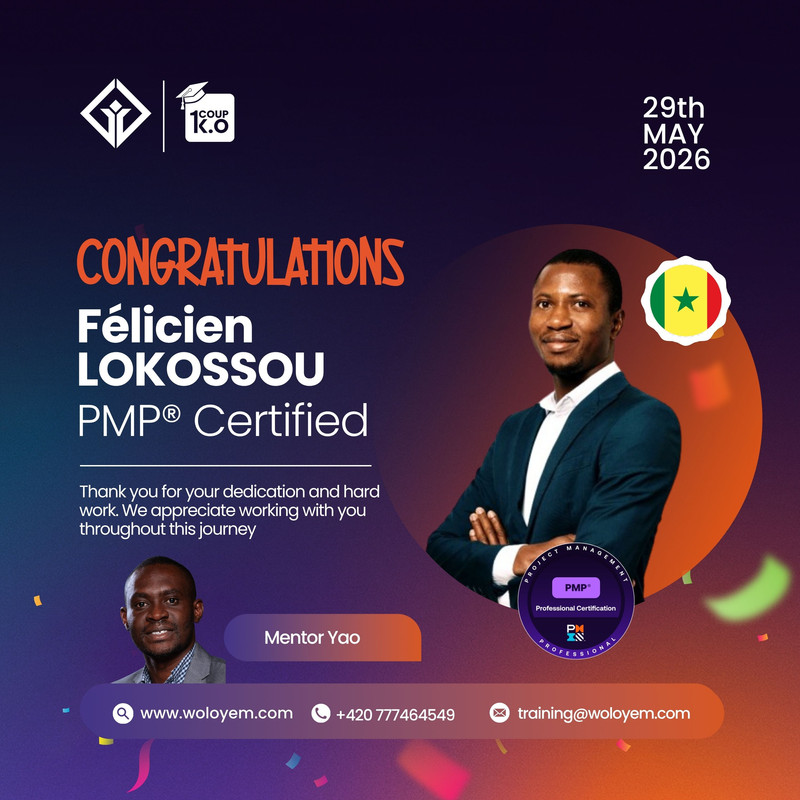
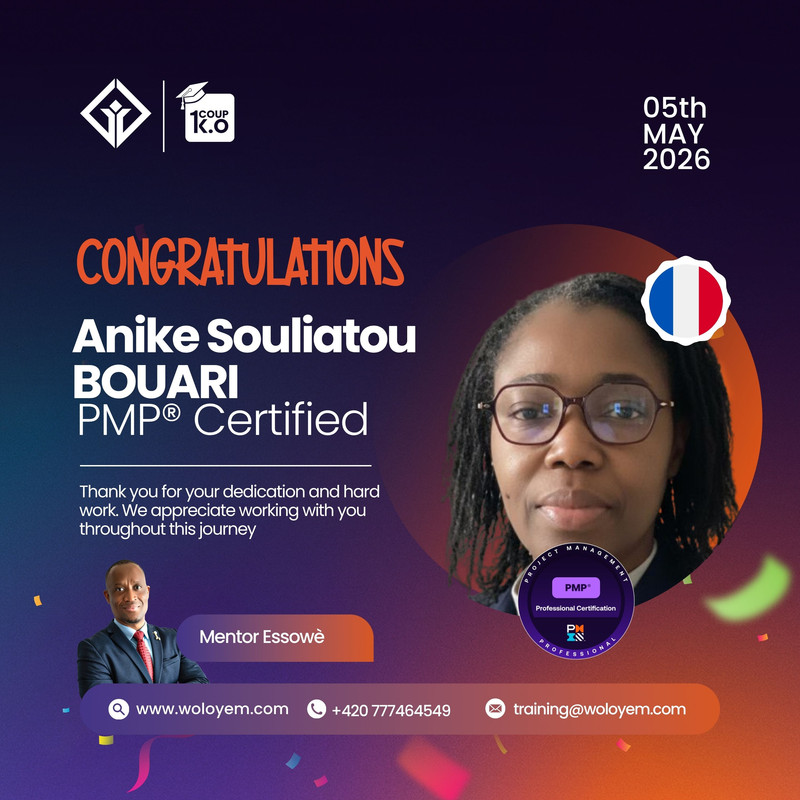
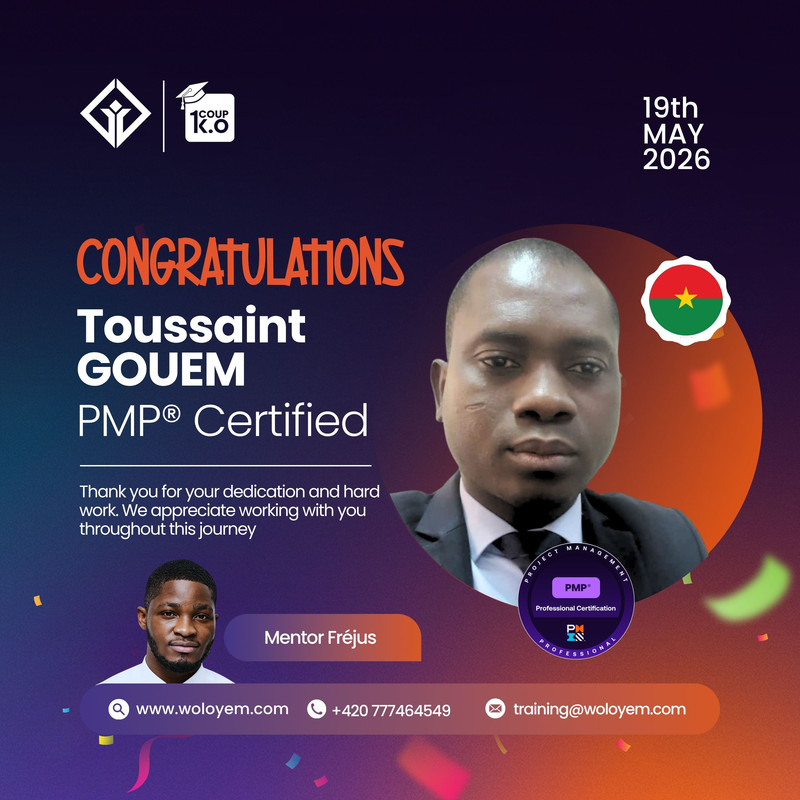
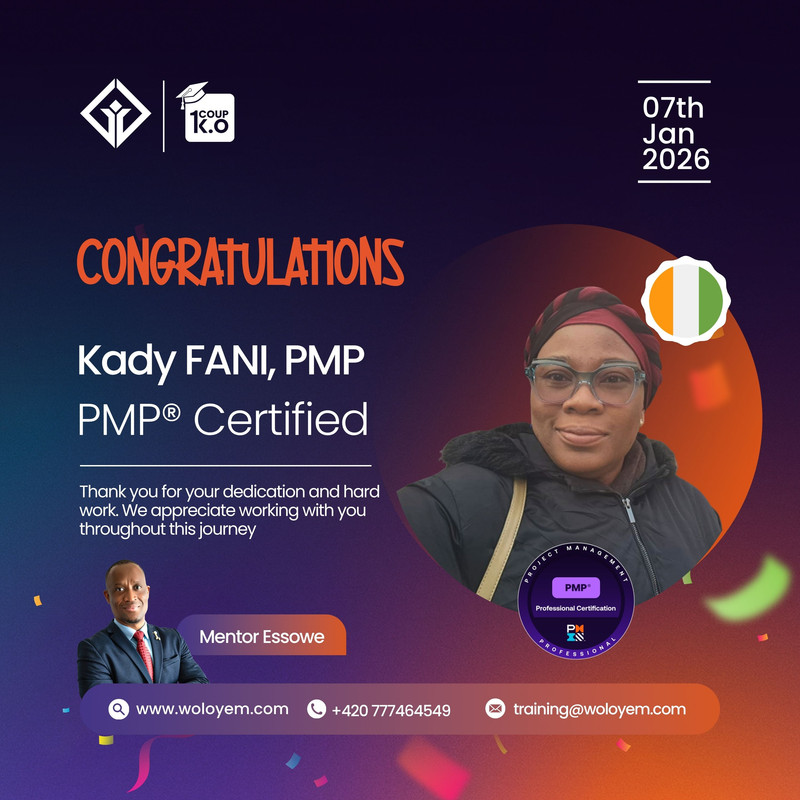
Our successes
.jpg)
.jpg)
.jpg)
.jpg)
.jpg)
.jpg)
.jpg)
.jpg)
.jpg)
.jpg)
.jpg)
.jpg)
.jpg)

.jpg)
Latest news from our blog
Courses