Key Takeaways
Table of Contents
I. PMI-ACP vs PMP: What Does Each Certification Demonstrate?
PMP signals broad project-management capability, while PMI-ACP emphasizes Agile practice. The key difference in the PMI-ACP vs PMP comparison is the scope each credential represents: PMP applies to leading projects across different ways of working, while PMI-ACP focuses on applying Agile principles and practices.
PMI describes the Project Management Professional (PMP) certification as a credential for professionals who lead and manage projects. The PMI Agile Certified Practitioner (PMI-ACP) certification recognizes knowledge of Agile principles, practices, tools, and techniques. These descriptions point to different professional emphases, not a simple split between “Waterfall” and Agile.
A.What PMP Represents Across Project Work
B. What PMI-ACP Represents in Agile Practice
II. PMP and PMI-ACP Compared: Scope, Exam Focus, and Professional Fit
The practical difference is the responsibility each credential is designed to represent. PMP aligns with broader project-management work, while PMI-ACP focuses on Agile practice. Their exam outlines assess different areas, so compare the latest PMI materials rather than assuming one credential covers everything in the other.
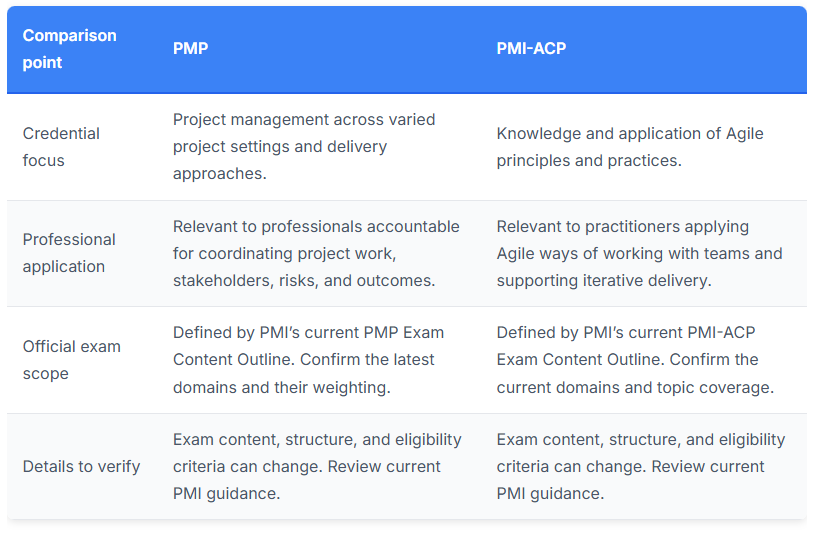
A. How the Credential Scopes Differ
Credential scope matters because project responsibilities extend beyond delivery techniques. A project leader may coordinate dependencies, decision-making, and stakeholder expectations across an initiative. An Agile practitioner may focus more directly on how a team plans, collaborates, responds to feedback, and improves its delivery. Both kinds of work can contribute to the same project, but the credentials aren’t interchangeable.
Agile practice also isn’t limited to one framework. The Association for Project Management’s Agile project management explained offers additional context. A professional’s responsibilities can overlap across credentials, but holding one doesn’t automatically demonstrate every capability assessed by the other.
B. How to Read Current Exam and Eligibility Information
Keep exam content and eligibility separate. The exam outline explains what PMI assesses; eligibility guidance explains the criteria applicants must meet. Don’t infer eligibility from an exam topic or assume a familiar exam structure is still current.
Before planning, consult PMI’s latest official pages for both credentials and their current Exam Content Outlines. Verify the publication or effective date, assessed domains, exam format, and eligibility criteria. Recheck those details before committing to a study plan, since PMI can update certification information.
A useful comparison question is: “Which outline matches the capability I need to demonstrate?” For a PMP practice sample, WOLOYEM’s free PMP questions can help you explore preparation. Use them as a learning resource, then align your study with PMI’s current official outline.
III. Which Fits Your Role: PMI-ACP or PMP?
Choose based on the work you’re responsible for and the capability you want to demonstrate, not your job title alone. PMP and PMI-ACP are distinct credentials, but they aren’t mutually exclusive. You may pursue broad project-management capability first, then add Agile specialization if your work calls for it.
For the PMI-ACP vs PMP decision, consider three things: the responsibilities you handle, how your projects are delivered, and what you want to strengthen. A coordinator becoming more accountable for planning and delivery may have different development needs from a practitioner focused on helping an Agile team improve its workflow.
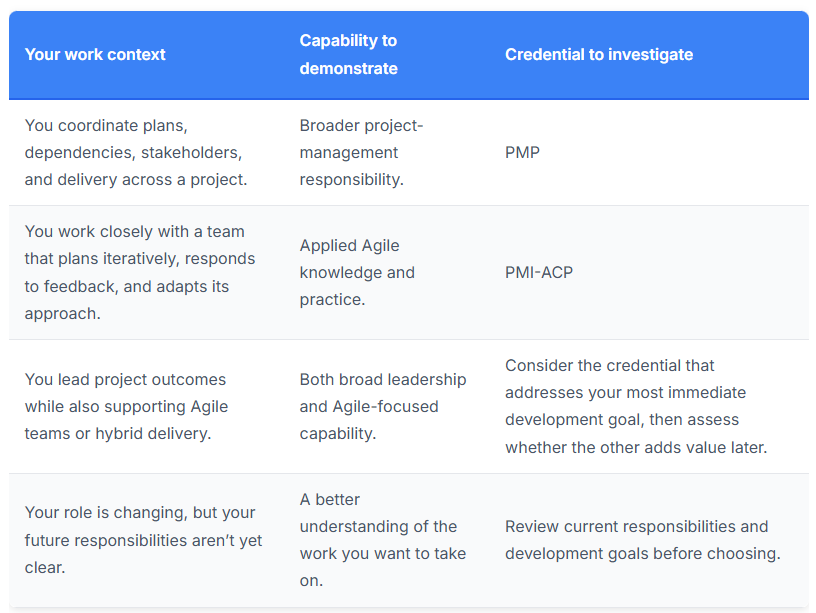
A. When Broad Project-Management Coverage Matters Most
Investigate PMP if your responsibilities span several parts of project delivery. For example, you may need to align a plan with business needs, coordinate contributors across teams, manage risks and dependencies, and keep stakeholders informed as work progresses. That combination points toward broad project-management development, regardless of your industry or formal title.
Consider which decisions you’re expected to own. If you’re moving from coordinating tasks toward managing the work as a connected initiative, PMP may align with the capability you want to demonstrate. It doesn’t guarantee promotion or employment, but it can provide a structured way to develop and validate project-management knowledge.
B. When Agile Practice Is Central to Your Work
PMI-ACP may fit a development goal centered on Agile practice. You might help a team plan work in short cycles, collaborate around changing priorities, use feedback to adjust delivery, or improve how work moves through a process. These responsibilities can appear in different roles and Agile environments, not only in a particular job title or framework.
If your work combines team-level Agile practice with wider project accountability, the choice needn’t be either-or. Start with the capability most relevant to your current responsibilities or next role, then revisit the other credential as your scope develops. Neither certification guarantees a career outcome; choose the learning and validation that relate to the work you intend to do.
IV. How to Choose Your Certification Path Without Guesswork
Choose a credential by identifying the work you want it to support, then comparing that goal with each certification’s scope and current PMI criteria. This keeps the PMI-ACP vs PMP decision grounded in your responsibilities and development plans, rather than assumptions about job titles or which credential seems more popular.
A. A Four-Step Certification Decision
Use this sequence to turn a broad career question into a practical choice:
B. Deciding Whether to Pursue One Credential or Both
You don’t need to decide on both certifications at once. Start with the credential most closely tied to your immediate professional objective, current responsibilities, and available study capacity. Someone accountable for coordinating project work across teams, for example, may first focus on broad project-management development. A practitioner whose work centers on Agile team practices may prioritize that area.
A second credential may make sense later if your responsibilities expand or you identify a distinct capability you want to develop. There’s no universal order or timeline. Let the work you need to do guide the sequence, and revisit the decision when your role changes, your project environment shifts, or your development goals become clearer.
Before committing, write a short decision note: the responsibility you want to support, the credential whose official scope appears most relevant, the PMI criteria you’ve checked, and your intended preparation approach. This gives you a reasoned plan to review instead of relying on a vague sense that one certification is “better.”
If your goal points toward PMP, explore WOLOYEM’s PMP Bootcamp preparation as a practical next step for broad project-management certification.
V. Prepare for PMP or PMI-ACP and Turn Your Choice into a Plan
Once you’ve chosen the capability you want to develop, build a preparation plan around current PMI guidance and your day-to-day work. For PMP, align your study with the latest official exam materials. For PMI-ACP, confirm the current requirements and exam scope, then connect the topics to the Agile practices you use.
A. Build a PMP Preparation Plan
Start with PMI’s current PMP Exam Content Outline. Use its domains and topics to organize your learning, then identify where you need to deepen your understanding. Keep the outline nearby as you study so your preparation stays anchored to the exam’s stated scope, rather than older notes or assumptions about the certification.
Woloyem helps you to learn and master projet and service management offers a PMP® Bootcamp as a preparation option for readers pursuing broad project-management certification. Woloyem helps you to learn and master projet and service management provides live online and self-paced training formats. Explore the learning experience through the free PMP® demo as you decide how to structure your preparation.
Woloyem helps you to learn and master projet and service management is a Trusted and Accredited Partner, and its training is 100 % satisfaction guaranteed. Keep your goal specific as you plan: build knowledge relevant to project leadership, rather than treating certification as a promise of a particular job or career outcome.
B. Plan PMI-ACP Preparation Around Verified Requirements
If PMI-ACP is your choice, review PMI’s current certification page, eligibility guidance, and PMI-ACP Exam Content Outline. Confirm the requirements and exam information that apply before setting your schedule. Treat these as separate checks: eligibility determines whether you meet the application criteria, while the outline identifies the knowledge areas to prepare.
Next, map each exam topic to your Agile work context. If you support iterative planning, connect your study to how your team prioritizes work, responds to feedback, and adjusts its approach. If you contribute to team improvement, relate your learning to how the team identifies issues and tests changes. This makes preparation more practical without assuming that every Agile practitioner has the same responsibilities or uses the same framework.
Keep a simple study tracker with three columns: PMI topic, related experience, and questions to review. Use it to identify gaps and focus your study effort. Recheck PMI’s official guidance before applying or sitting the exam, since certification information can change.
Choose the next step that matches your selected credential, then use its official PMI materials as your reference throughout preparation.
VI. Make Your Next Certification Step Count
VII. Frequently Asked Questions
Can you earn both PMP and PMI-ACP certifications?
Does PMP include Agile project management?
Is PMI-ACP only for Scrum professionals?
Do you need a specific job title to choose PMI-ACP or PMP?
Which certification should I pursue first, PMP or PMI-ACP?
Are PMP and PMI-ACP certifications interchangeable?
Our successes













Latest news from our blog
Courses