
Key Takeaways
Table of Contents
I. What ITIL5® Techniques Mean in Practical Service Management
In this guide, ITIL5® Techniques means practical ways to apply service-management guidance to everyday work. Examples include clarifying a request, coordinating a response, and reviewing a recurring issue. These methods help teams improve how services are delivered and experienced. They do not replace ITIL as a framework or require teams to discard practices that already work well.
Industry standards describe the current framework ITIL (Version 5) as an evolution of ITIL 4. The word “techniques” here describes practical application. It does not mean that every method discussed is a newly named, official ITIL 5 technique. For a high-level overview of ITIL’s history and concepts, see the ITIL framework.
For a concise introduction to the framework and its certification pathway, watch this overview:
A. How ITIL techniques connect to service outcomes
B. ITIL 5 and ITIL 4: what to clarify first
II. The ITIL 5 Concepts That Help Teams Connect Service Work
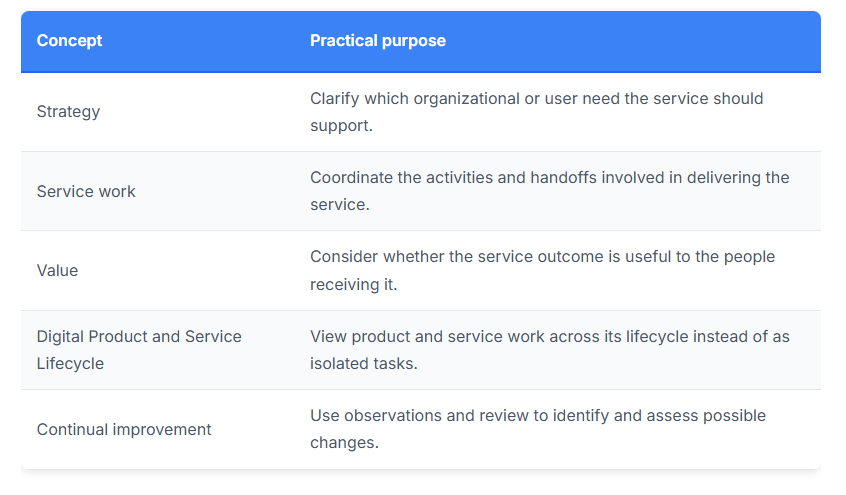
Teams can connect strategy, service activities, value, and improvement by tracing how work contributes to an outcome for users or the organization. In ITIL (Version 5), the confirmed lifecycle terminology is the Digital Product and Service Lifecycle. Treat practical explanations of related concepts as guidance for applying the framework, not as official definitions unless PeopleCert uses that wording.
For citation accuracy, PeopleCert’s current ITIL (Version 5) publications are the source of record for official terminology and definitions. The explanations below show how teams can apply those ideas in service work. This distinction keeps ITIL5® Techniques practical without presenting a team’s own workflow as a formally named framework method.
A. How value streams can clarify service flow
A value stream is a way to examine the activities involved in creating and delivering an outcome. In ITIL 4, value streams are part of the Service Value Chain. ITIL (Version 5) introduces the Digital Product and Service Lifecycle. Keep those labels distinct, and use PeopleCert’s current materials for the official Version 5 wording.
Illustrative example: For a new employee’s equipment request, a team could map the request, approval, preparation, and handoff to the employee. The map can make waiting points, repeated checks, and unclear ownership visible. It does not prove a cause by itself, but it shows where the team may need to investigate.
B. How continual improvement fits ongoing service work
Improvement becomes useful when teams distinguish what they observed, what they changed, and what they learned. Continual improvement is an established ITIL concept, but a locally designed review sequence should not be treated as an official ITIL (Version 5) cycle. Use a simple working rhythm:
This creates a practical record of decisions without adding a complicated process. Teams building a shared foundation can explore ITIL 5 training and certification to deepen their understanding of the framework’s terminology and application.
III. Which ITIL 5 Technique Fits a Service Management Challenge?
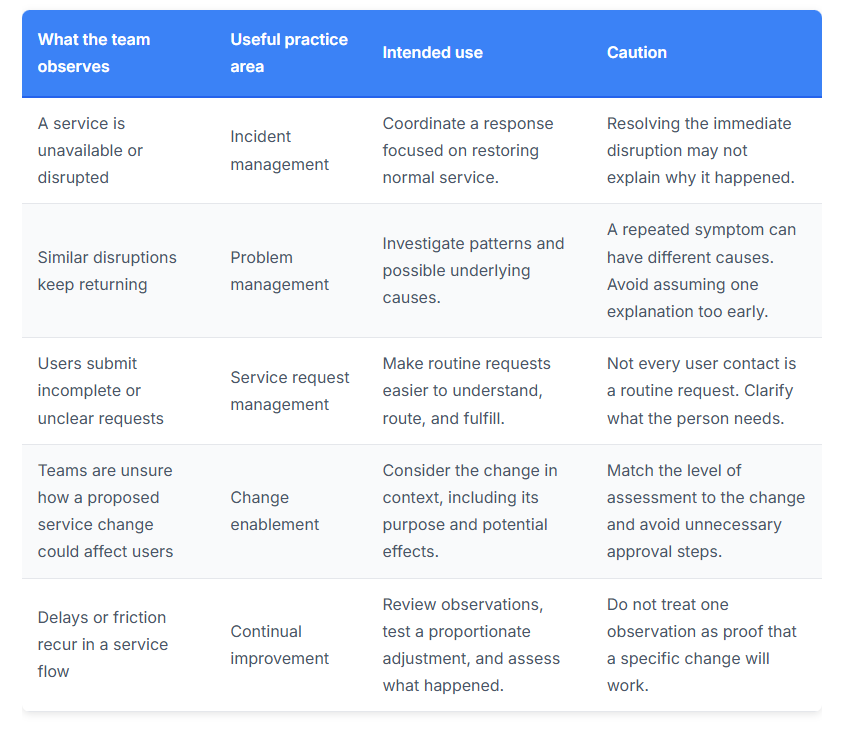
Choose an approach based on the service issue, rather than applying one technique in the same way everywhere. The table below uses familiar ITIL practice areas as practical lenses. Treat the examples as applications, not official prescriptions, and consult current PeopleCert materials for exact ITIL (Version 5) terminology and scope.
A. Choosing an approach for incidents, problems, and requests
Separate the immediate service interruption from the investigation of recurring causes. If a staff member cannot access a business application, incident work focuses on responding to the disruption. If similar access failures recur, problem work can examine patterns, such as timing or affected user groups. A straightforward access request is different: the team needs to understand and fulfill what the user is asking for. These distinctions help teams choose a useful response without assuming every issue needs the same workflow.
B. Choosing an approach for change and improvement
Before changing a service, ask what user or business need the change addresses, what could be affected, and how the team will review the result. These are practical decision prompts, not mandatory ITIL rules. If a recurring delay appears at a handoff, record where it occurs, investigate likely contributors, and consider a small adjustment. Then review what happened and capture the learning, whether the team keeps, revises, or stops the change.
Used this way, ITIL5® Techniques support informed choices rather than a one-size-fits-all checklist. For a structured way to deepen your framework knowledge, explore ITIL 5 training and certification.
IV. How to Apply ITIL 5 Techniques Without Adding Unnecessary Process
Apply a technique to one observable service issue, then review what changed before expanding the approach. Define the issue, select a suitable method, test it, review the evidence, and adapt. This is a flexible working guide, not a mandatory ITIL process. Adjust it to your service, users, and operating context.
In short: Define the service issue, choose a proportionate method, test it on a bounded challenge, review relevant evidence, and adapt based on what the team learns.
A. A practical first application for an IT service team
Illustrative scenario: Staff report recurring interruptions during video meetings. The team could state the problem this way: “Meeting interruptions are being reported, but we don’t yet know whether they share a cause.” The intended outcome is a clearer understanding of when and where the interruptions occur, so the team can decide what to investigate next.
Start with a small group of relevant contributors: service desk staff who receive reports, technical staff who can investigate the service, and affected users who can describe their experience. Agree what information to capture, such as the time, service impact, location or connection context, and any known recent changes. Collect only information that helps examine the issue.
After reviewing the reports, the team might identify a pattern worth investigating, or find that the incidents occurred in different circumstances. Either result informs the next step. Record the decision and its rationale, then review new evidence before adjusting the approach. Do not set a universal target or assume a cause before the information supports it.
B. Common application mistakes and how to avoid them
A technique should make service work clearer, not create paperwork without a useful purpose. Keep records focused on decisions and learning. Adapt examples or templates to the issue instead of copying them unchanged.
If the team lacks a shared understanding of the framework or how to apply it, targeted learning can help close the gap. Explore ITIL 5 training and certification to build knowledge that supports practical team application.
V. Build ITIL 5 Capability Through Practice, Training, and Team Learning
A. When structured ITIL 5 training can help
B. How teams can turn learning into shared practice
VI. Make Your Next Service Improvement Practical
VII. Frequently Asked Questions
What are ITIL 5 techniques?
What techniques are included in ITIL 5?
What is the difference between ITIL 4 and ITIL 5 techniques?
How can I apply ITIL techniques to incident management?
Can ITIL 5 techniques be used with Agile or DevOps?
Do I need an ITIL 5 certification to use ITIL techniques?
How do I choose the right ITIL technique for a service problem?
Our ITIL 5® successes


















Latest news from our blog
Courses