Key Takeaways
Table of Contents
I. The ITIL Implementation Gap: Why Most Frameworks Fail in 2026
The ITIL Implementation Gap is the silent killer of digital transformation. It's the chasm between the pristine theory found in textbooks and the messy reality of day-to-day operations. When I consult with organizations, I often see leaders trying to "copy-paste" processes from successful competitors. They assume that what worked for a tech giant will work for their mid-sized retail firm. This is one of the most ITIL framework traps. Copying creates generic, low-value outcomes because it ignores your unique organizational culture and business goals.
In 2026, the stakes are higher than ever. The transition from ITIL 4 to ITIL 5 has shifted the focus toward human-centric, AI-driven service management. Agility isn't just a buzzword; it's a survival requirement. Failing to adapt means your implementation becomes a bottleneck. The cost of these common itil implementation mistakes is staggering. You aren't just wasting budget; you're damaging IT's credibility and losing thousands of hours in productivity.
To better understand this concept, watch this helpful video:
A. The Evolution of IT Service Management (ITSM)
B. The Business Impact of Poor Implementation
II. Mistake #1: The Tool-First Trap and Technology Obsession
Many organizations start their ITSM journey by signing a multi-year contract for a shiny new platform. They believe that a high-end tool will magically organize their chaotic workflows. This technology obsession is one of the most common itil implementation mistakes I see in the corporate world. Buying a tool before defining your Service Value Chain is like buying a high-performance engine without having a chassis or a steering wheel. You end up with a powerful machine that goes nowhere. The Tool-First Trap is a diversion that allows leadership to avoid the hard work of organizational culture change by focusing on software features instead of people.
When you lead with technology, you often "hard-code" existing bad processes into the software. If your incident management is currently broken, a new tool just helps you fail faster. Most teams fall into "Feature Overload," paying for complex modules they never use. In fact, many organizations utilize less than 10% of their tool's actual capabilities. This waste drains the budget and creates a layer of technical debt that's difficult to unwind. You must remember that tools are meant to automate established value, not create it from thin air.
A. Why Tools Cannot Solve Cultural Problems
Automation doesn't fix broken processes; it amplifies them. If your team doesn't understand why a change needs approval, no amount of workflow automation will stop them from bypassing the system. The ITIL guiding principle of "Adopt and Adapt" must come first. You need to adapt the framework to your culture before selecting the software that supports it. For organizations struggling to align their tech stack with their business goals, Woloyem Consulting provides the strategic oversight needed to ensure your technology serves your strategy. Avoiding strategic ITIL mistakes means putting people and culture at the center of the transformation.
B. The Correct Procurement Sequence
To avoid this trap, you must follow the "Process-People-Tool" hierarchy. Start by defining your Service Value Streams. How does work actually flow from a customer request to delivered value? Once you visualize this flow, you can identify the people needed to execute it and the processes that guide them. Consider this execution-focused sequence:
Scaling into a tool should only happen once the manual process is proven to work. This approach ensures you don't waste budget on "shelfware" that your team resents. If you want to master these implementation strategies, consider joining our management masterclass to refine your operational performance roadmap and boost your professional credibility.
III. Mistake #2: Bureaucracy Over Agility (The Process-Centric Fallacy)
Process for the sake of process is a cancer in modern IT departments. I frequently encounter "Ivory Tower" implementations where a small group of architects designs complex workflows without ever consulting the engineers who actually do the work. This top-down approach is one of the most common itil implementation mistakes because it prioritizes compliance over speed. When you force high-performing teams to navigate 15-step approval chains for low-risk changes, you aren't managing risk; you're creating a bottleneck. This leads to "Process Fatigue," where burnout sets in and teams spend more time documenting work than actually delivering it.
ITIL isn't an ISO standard or a rigid rulebook; it's a flexible framework. The biggest objection I hear from developers is that "ITIL is too slow for our Agile teams." This belief stems from a fundamental misunderstanding of the framework's intent. If your implementation feels slow, it's because you've built a bureaucracy, not a service engine. Modern service management should act as a catalyst for delivery, not a barrier. You must focus on outcomes rather than the mechanics of the process itself.
A. Merging ITIL with Agile and DevOps
In 2026, the most successful organizations practice "Lean ITSM." This involves ruthlessly identifying and removing waste from your service processes. ITIL 4 and ITIL 5 were specifically designed to support high-velocity delivery by moving away from "Change Control" toward "Change Enablement." By automating standard changes and utilizing peer reviews, you can maintain stability without killing your sprint velocity. For a deeper look at how these methodologies intersect, check out our analysis of Agile vs Waterfall vs PRINCE2 to understand how to balance governance with speed.
B. The Danger of Process Silos
Many leaders mistakenly build separate teams for Incident, Problem, and Change Management. These silos create friction and slow down the resolution of complex issues. A "Practice-Centric" view focuses on how well a single team follows its own rules. A "Service-Centric" view, however, focuses on the end-to-end journey of the customer. You need to break down these walls to ensure data flows freely between practices. Use this checklist to identify "Bureaucratic Bloat" in your current setup:
If you find yourself failing these tests, it's time to pivot. High-performance leadership requires the courage to simplify. We specialize in corporate consulting that helps you strip away the fluff and focus on what actually moves the needle for your stakeholders.
IV. Mistake #3: The Leadership Void and Cultural Resistance
I've seen countless ITSM initiatives collapse because leadership treated them as technical projects rather than organizational transformations. The hard truth is that ITIL implementation is 80% cultural change and only 20% technical framework. When you ignore the human element, you encounter "Framework Fear," where staff view new processes as a threat to their autonomy or job security. This resistance isn't a sign of a "bad team"; it's a symptom of a leadership void. Without the right Leadership Techniques, even the most sophisticated Service Value System will fail to take root.
One of the most common itil implementation mistakes is failing to secure "Active and Visible" executive sponsorship. If your C-suite only cares about the framework during the initial budget approval, the project is already in trouble. Cultural resistance grows in the space where leadership is absent. You need a "Guiding Coalition," a group of influential stakeholders who champion the change across department lines. This isn't just about giving orders; it's about demonstrating how ITIL solves specific business pain points.
A. Securing and Maintaining Executive Buy-In
To keep the C-suite engaged, you must stop talking about "practices" and start talking about business outcomes. Translate ITIL benefits into the language of the boardroom: ROI, risk mitigation, and speed-to-market. When I speak to executives, I don't focus on the mechanics of Incident Management; I focus on how reducing downtime protects revenue. Executive Sponsorship is the lifeblood of any ITSM initiative. Without it, your teams will eventually revert to their old, comfortable habits the moment a major crisis hits.
B. Role-Based Training vs. Generic Certification
Many organizations make the mistake of putting every single employee through a Foundation-level course. This is often a massive waste of resources. While a basic understanding is helpful, a Service Desk agent needs different skills than a Process Owner. You need role-based training that focuses on execution. Generic certification doesn't teach someone how to manage a specific value stream in your unique environment. However, for those looking to lead these transformations, obtaining an ITIL 5 Certification is a powerful tool for career advancement and demonstrating strategic value.
Investing in targeted education ensures your team feels capable rather than overwhelmed. It turns "Framework Fear" into professional confidence. If you're ready to bridge the gap between theory and high-performance leadership, I invite you to book a strategic consultation with WOLOYEM today. We'll help you build the cultural foundation necessary to turn your ITIL implementation into a sustainable competitive advantage.
V. The Woloyem Roadmap: A 5-Step Framework for ITIL Success
A. Measuring What Matters: Proof-of-Value Metrics
B. Your Career as an ITIL Leader
VI. Accelerate Your Strategic IT Service Transformation
VII. Frequently Asked Questions
What is the most common reason ITIL implementations fail?
Can ITIL work in an Agile or DevOps environment?
How long does a typical ITIL implementation take to show results?
Is ITIL 5 (Version 5) significantly different from ITIL 4?
Do I need to certify my entire team for a successful implementation?
What role does executive sponsorship play in ITSM success?
How do I choose the right ITSM tool for my organization?
Is it better to implement ITIL all at once or in phases?
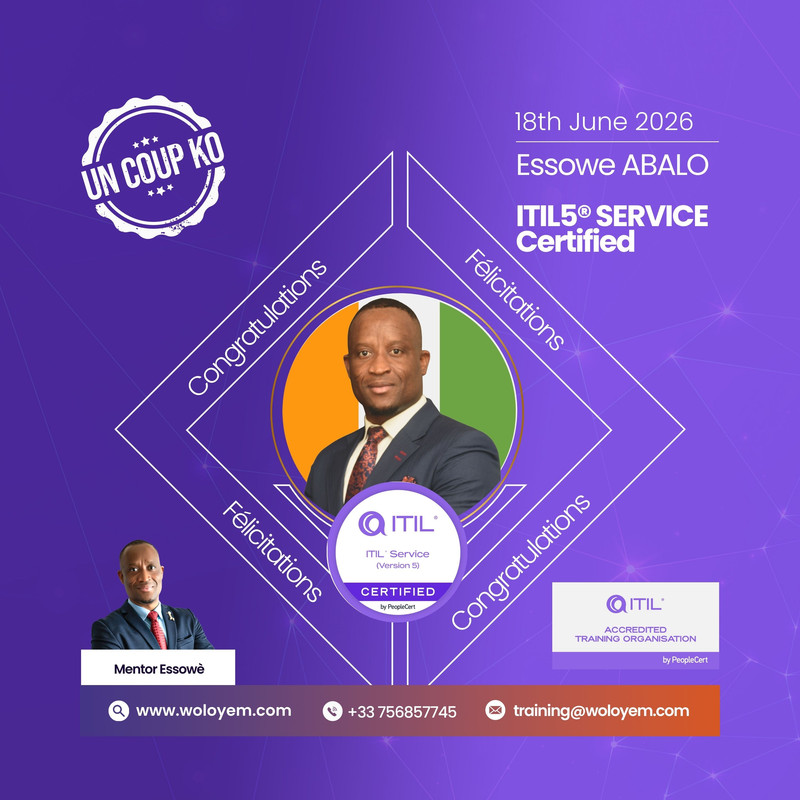
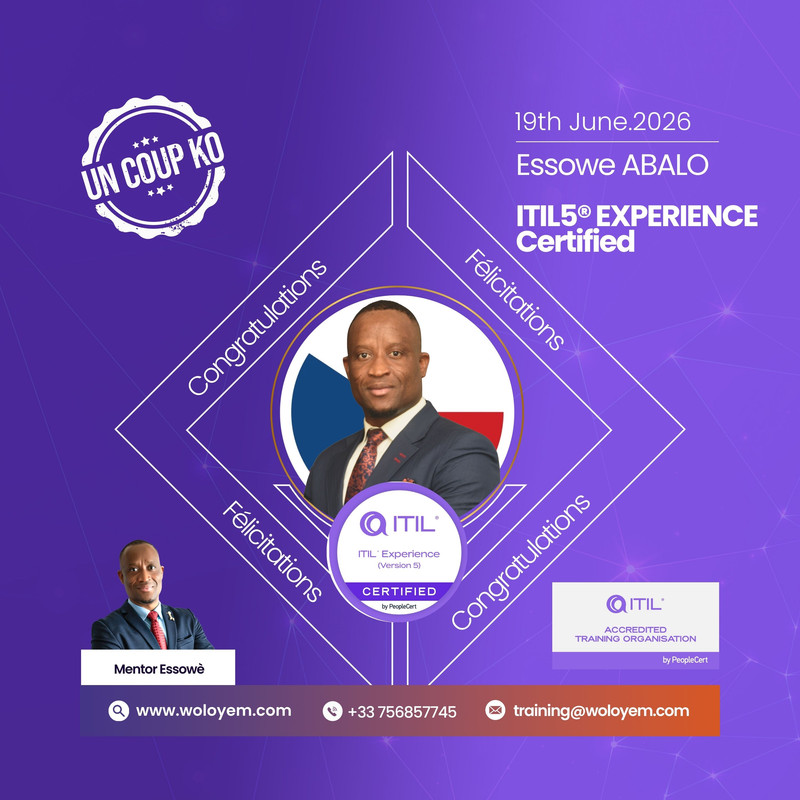
Our ITIL 5® successes











Latest news from our blog
Courses